 Myrmecochory
Common
Rarity: Common
The most frequent rarity: most Wikipedia articles become Commons.
Rarity follows how well known the article is: its views on the French and English Wikipedia over a year, and the number of languages it exists in.
At a glance
- Class
- Notion
- Domain
- Science and technology
- In collections
- Nobody has pulled it yet.
What Wikipedia says
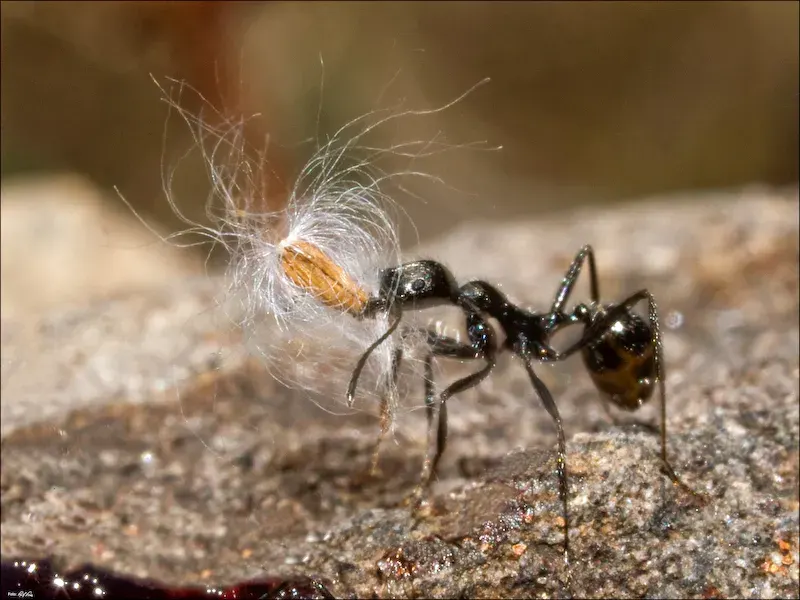
Myrmecochory ( (sometimes myrmechory); from Ancient Greek: μύρμηξ, romanized: mýrmēks ("ant") and χορεία khoreíā ("circular dance") is seed dispersal by ants, an ecologically significant ant–plant interaction with worldwide distribution. Most myrmecochorous plants produce seeds with elaiosomes, a term encompassing various external appendages or "food bodies" rich in lipids, amino acids, or other nutrients that are attractive to ants. The seed with its attached elaiosome is collectively known as a diaspore. Seed dispersal by ants is typically accomplished when foraging workers carry diaspores back to the ant colony, after which the elaiosome is removed or fed directly to ant larvae. Once the elaiosome is consumed, the seed is usually discarded in an underground midden or ejected from the nest. Although diaspores are seldom distributed far from the parent plant, myrmecochores also benefit from this predominantly mutualistic interaction through dispersal to favourable locations for germination, as well as escape from seed predation.
Excerpt from the Wikipedia article “Myrmecochory”, under the CC BY-SA 4.0 license. Read the article on Wikipedia
Image: Rolf Fries, CC BY-SA 3.0, via Wikimedia Commons.
Open free boosters and add Myrmecochory to your collection.
Play for free