
 Pascal's theorem
Uncommon
Rarity: Uncommon
A topic a little better known than average, read and translated beyond its own country.
Rarity follows how well known the article is: its views on the French and English Wikipedia over a year, and the number of languages it exists in.
At a glance
- Class
- Notion
- Domain
- Science and technology
- In collections
- Nobody has pulled it yet.
What Wikipedia says
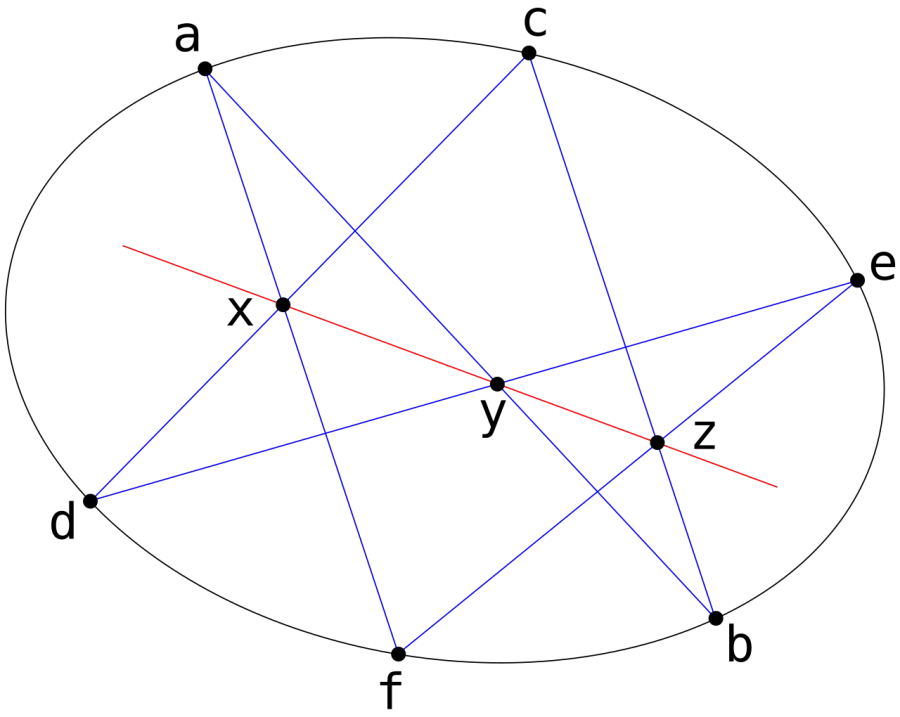
In projective geometry, Pascal's theorem (also known as the hexagrammum mysticum theorem, Latin for mystical hexagram) states that if six arbitrary points are chosen on a conic (which may be an ellipse, parabola or hyperbola in an appropriate affine plane) and joined by line segments in any order to form a hexagon, then the three pairs of opposite sides of the hexagon (extended if necessary) meet at three points which lie on a straight line, called the Pascal line of the hexagon.
Excerpt from the Wikipedia article “Pascal's theorem”, under the CC BY-SA 4.0 license. Read the article on Wikipedia
Image: Romainbehar, Public domain, via Wikimedia Commons.
Open free boosters and add Pascal's theorem to your collection.
Play for free