 Nganasan language
Rare
Rarity: Rare
A topic known well beyond its field, found in many languages.
Rarity follows how well known the article is: its views on the French and English Wikipedia over a year, and the number of languages it exists in.
At a glance
- Class
- Notion
- Domain
- Society
- In collections
- Nobody has pulled it yet.
What Wikipedia says
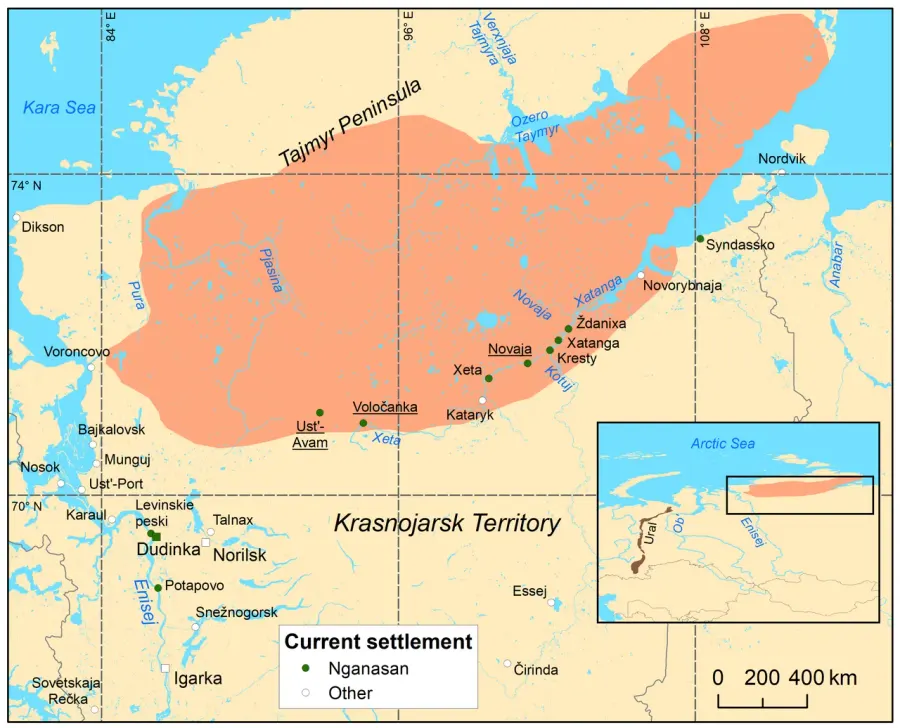
The Nganasan language (formerly called тавгийский, tavgiysky, or тавгийско-самоедский, tavgiysko-samoyedsky in Russian; from the ethnonym тавги, tavgi) is a moribund Samoyedic language spoken by about 30 of the Nganasan people, who are native to the Taymyr Peninsula in northern Siberia, residing primarily in the settlements of Ust-Avam, Volochanka, and Novaya in the Taymyrsky Dolgano-Nenetsky District of Krasnoyarsk Krai, with smaller populations residing in the towns of Dudinka and Norilsk as well.
Excerpt from the Wikipedia article “Nganasan language”, under the CC BY-SA 4.0 license. Read the article on Wikipedia
Image: Rantanen, T., Tolvanen, H., Roose, M., Ylikoski, J. & Vesakoski, O. (2022) “Best practices for spatial language data harmonization, sharing and map creation – A case study of Uralic” PLoS ONE 17(6): e0269648. https://doi.org/10.1371/journal.pone.0269648. Rantanen, Timo, Vesakoski, Outi, Ylikoski, Jussi, & Tolvanen, Harri. (2021). Geographical database of the Uralic languages (v1.0) [Data set]. Zenodo. https://doi.org/10.5281/zenodo.4784188, CC BY 4.0, via Wikimedia Commons.
Open free boosters and add Nganasan language to your collection.
Play for free